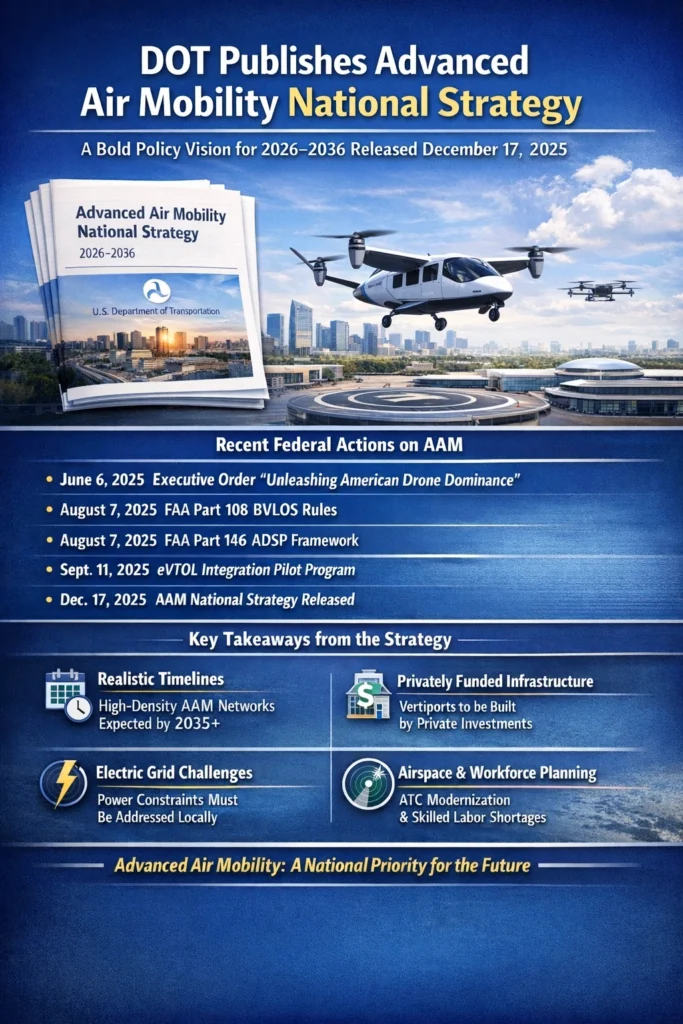
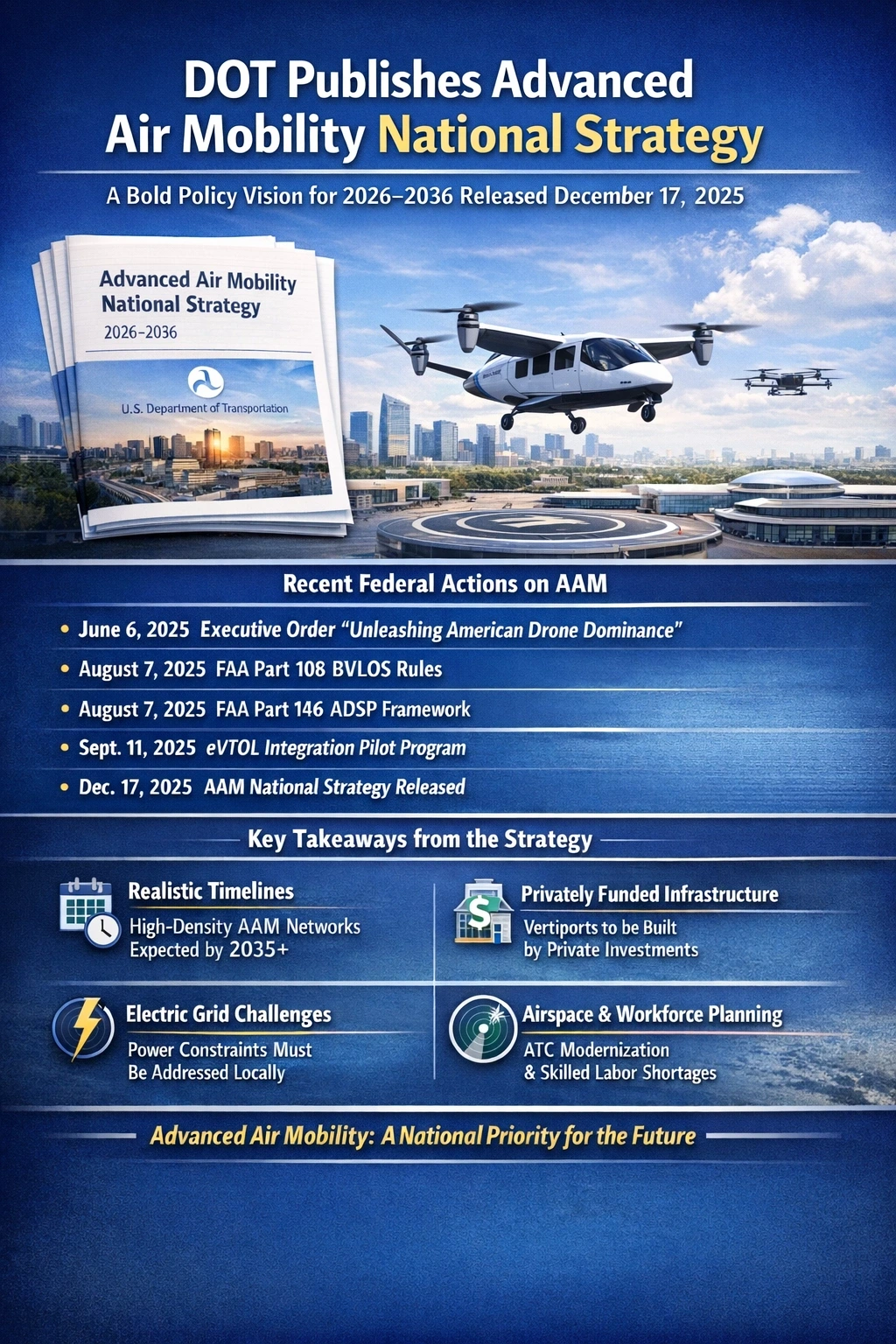
The U.S. Department of Transportation has released The Advanced Air Mobility National Strategy: A Bold Policy Vision for 2026–2036, a 70-page document published December 17, 2025, developed over nearly three years with input from more than 100 experts across 25 federal agencies. The strategy is designed to position the United States as a global leader in Advanced Air Mobility (AAM).
This marks the fifth major AAM-related federal action in the past six months, underscoring sustained Administration focus:
- June 6, 2025 – Executive Order 14307, “Unleashing American Drone Dominance”
- August 7, 2025 – FAA Part 108 NPRM for BVLOS UAS operations
- August 7, 2025 – FAA Part 146 ADSP certification framework
- September 11, 2025 – FAA/DOT eVTOL Integration Pilot Program (eIPP)
- December 17, 2025 – AAM National Strategy published
Together, these actions provide a clearer policy and regulatory runway for AAM stakeholders, including XTI Aerospace.
Key Takeaways from the Strategy
1. Realistic Timelines
The strategy resets expectations with a phased, practical outlook:
- 2027: Demonstrations and limited operations using existing infrastructure
- 2030: Expanded urban and rural operations supported by privately funded vertiports
- 2035+: Fully autonomous operations in defined regions
High-density, fully automated AAM networks are now officially projected for 2035 or later, aligning with certification and production realities long understood by industry professionals.
2. Infrastructure Will Be Privately Funded
The DOT makes clear that vertiport development will be primarily privately funded, with public-private partnerships encouraged. Early operations are expected to leverage existing infrastructure, including nearly 13,000 U.S. airports, rather than rely on new federally funded, purpose-built facilities.
3. Electric Grid Constraints
The strategy acknowledges that electrical capacity for eVTOL charging is a major bottleneck and that solutions will need to be localized. Responsibility for addressing power availability will largely fall on operators and infrastructure partners—not the federal government.
Notably, XTI’s TriFan 600 does not rely on grid charging, enabling immediate deployment across existing airports, heliports, and numerous other safe landing areas—representing a clear operational advantage.
4. Community Authority and Noise
The document emphasizes coordination between federal airspace authority and state, local, and tribal land-use control. Community engagement is identified as critical. On noise, the DOT calls for standardized, non-proprietary data, noting that current assessments are largely anecdotal.
5. Airspace Technology Gap
Current ATC systems are not designed to support AAM at scale. The strategy supports the development of automated, data-driven airspace management via FAA-supervised third-party service providers. ATC modernization is identified as a top federal priority.
6. Workforce Challenges
The strategy highlights workforce retraining needs as propulsion technologies evolve. With existing pilot and technician shortages, workforce planning is recognized as a potential limiting factor for AAM growth.
Conclusion
The DOT’s AAM National Strategy presents a sober, credible assessment of the challenges ahead while reinforcing strong federal commitment to the sector. By clearly defining timelines, funding realities, and technical constraints, the strategy allows industry participants to recalibrate expectations and plan accordingly. With five major policy actions in six months, it is evident that Advanced Air Mobility is now a sustained national priority.
Saleem Zaheer
Editor-in-Chief
Hangar X Studios